About the person

(Photo: Marc Handler)
Marc Handler is an American producer, writer, dubbing director and editor for film and television, known for his work on Cowboy Bebop, Astro Boy, Power Rangers and Voltron, amongst others. He has worked as a creative director for Sony in Japan and for China Central Television (CCTV). Thanks to his expertise and knowledge of the Asian television market, he has already brought numerous anime series to Western audiences.
Prior to these milestones, Marc Handler also worked at World Events Productions (WEP) as executive story editor for Saber Rider and the Star Sheriffs, playing a leading role in developing the new storyline and characters.
Interview with Marc Handler
In late 2023, we had the special opportunity to ask Marc Handler a few questions. A big thank you goes to Daniel from the fan site Saber Rider Toy Collection for putting us in touch with Marc Handler and giving us the chance to submit questions. The following questions were posed by Daniel, April Eagle Wilcox, Sensei Usagi and Marcus (Herb).
We had already presented the answers received in February 2024 at our chat theme evening on 23 March 2024.
We’ll start with a personal statement from him, in which he describes his impressions, goals and challenges from that time. This is followed by our questions to him.
 The German translation of the interview is available here.
Marc Handler:
Modifying the original series was part of my job. There was a lot of conjecture about this, so I will try to clarify. We had great respect for Studio Pierrot. I worked with them directly in Tokyo and they were great animators and great people. We made all changes with respect and with their permission. They understood and had no problem with the changes that we made because they understood that those changes were necessary in order to get the show on the air and accepted in the US. That was advantageous to them as much as to us.
Most changes we made to the original story were to conform to the broadcast standards and cultural standards of the time, particularly the sensibilities of American parents at the time. It was mostly about minimizing violence. If there was too much violence, local stations would not have bought the series, so no one would have seen it. So, for a production company like WEP, the choice was either soften the violence or don’t do the series, because no one in the US would broadcast it in its original form.
From a personal viewpoint, I would be happy to do an adult version of Saber Rider that had normal adult standards. That would be great fun. But for its intended original audience of children, I think the standards we set and maintained were reasonable.
- Why was Saber Rider chosen as the leader of the Star-Sheriffs? If Fireball had been chosen as the leader, like in the original, there would have been less effort while reworking the series.
That decision was made by executive producer Peter Keefe. He thought Saber Rider had the best attitude and look to be the leader for an American audience. Saber Rider was calm, cool headed, and strategic which made him seem like a leader as compared to Fireball who was more emotional and hot-headed, so Fireball was a great character, but less like a leader. This was largely a personal call by Keefe; this idea appealed to him personally and conformed to his idea of a military leader. Keefe had been an M.P. (Military Policeman) in the US military, so I think he saw Saber Rider as having the right personal qualities for the leader of a group of Star Sheriffs. Fireball’s look fit for the original Japanese audience, but Saber Rider’s “golden boy” appearance fit with American/Western culture and made him distinct from the other male characters, so for Keefe it worked visually.
- Was it really intended for Saber Rider and April to get closer and become lovers? Why wasn’t that idea pursued further?
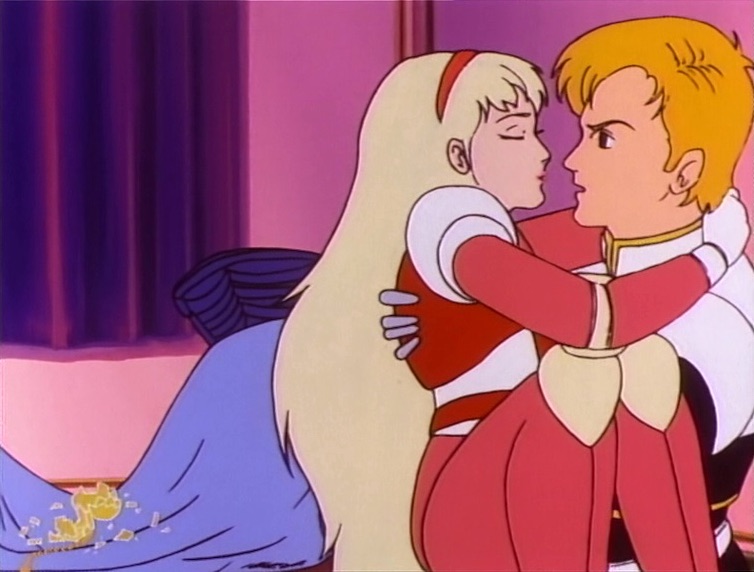
No, it was never our intention for Saber Rider and April to become lovers. If you look at American kids shows of that time, I don’t think you will find any that have child or teenage lovers. Viewers were too young to be interested in that. When we hinted at it, it enriched the stories. Some viewers would like to imagine “what if?” and to think about the possibilities. So, we introduced that idea and raised it as a “maybe,” as an intriguing question, but that question was meant to remain hanging; it was not meant to be resolved. This is similar to the Lois Lane – Superman relationship of that time period… the romance is latent, never realized.
- How did it come to the brilliant idea of making Jesse Blue a human who switched sides to the Outriders because of his unrequited love for April?
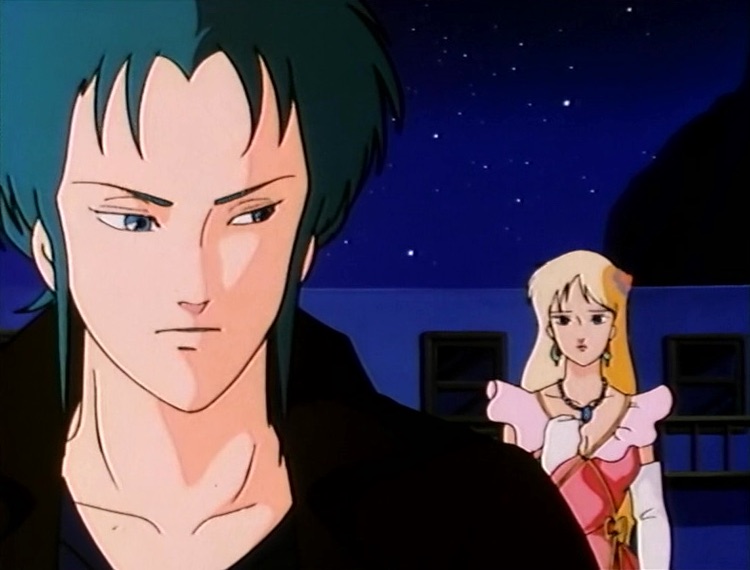
Thanks for the kind words. As story editor and writer that was one of the issues that I was responsible for. In this case, Jesse Blue already existed in the Japanese version, and he was an interesting character, so I wanted to give him more moves, more attitude, more surprises, and more human emotions to enrich the series. This also allowed us to make April stronger; she had to be strong enough to stand up to him. When you have a strong, resourceful bad guy, this forces the heroes to be stronger and more resourceful to deal with them. So, it elevates and intensifies the story. Today tough female characters are de rigueur, but at that time, it was relatively rare and, in this case, it made sense because Jesse was just a cadet while April was a veteran and a martial arts trainer. This whole direction was a natural development of the characters that already existed. It wasn’t a change in direction, just a deeper look into the who these characters were.
By the way, several people who have written about this wrote that Jesse was trying to rape April [NB: in the episode „Jesse’s Revenge“]. That shocked me. It is not correct, and nothing like that is stated in the scene. He is trying to kiss her, nothing more. She stops him by throwing him with a skillful martial art move. That’s it.
- What were the specific reasons for leaving out the five episodes of the Japanese original, the so called „Lost Episodes“?
The goal at the time was to create new episodes that established the basis for the American version of the series: e.g. putting Saber Rider in the lead position in the group. Establishing a more Western world for the series. Making Jesse Blue a more complex, interesting, and human enemy. Making April a little tougher and more mature. Adding some interesting and admirable Native American (American Indian) characters, since a Western setting would naturally include Native Americans. So these episodes replaced some of the other episodes which were not the strongest episodes in the series. I don’t think those episodes were particularly violent, we selected them out because they were not the best episodes at least for an American audience.
- How did the production of WEP’s own episodes go? Were there any conditions/restrictions from Studio Pierrot? Which company was commissioned to draw these episodes or were artists from Studio Pierrot commissioned?
MY BEST RECOLLECTION: Studio Pierrot did all of the artwork. They made the decisions regarding the designs. The difference in the artistic look between the original designs and the designs for the WEP episodes were because of changes at Studio Pierrot. It was a few years later; I believe they had some different directors and artists and they had evolved as a studio. I don’t recall any key instructions that we gave them about the look of the show. We wanted it to essentially match the other episodes, so viewers experienced it as one complete series.
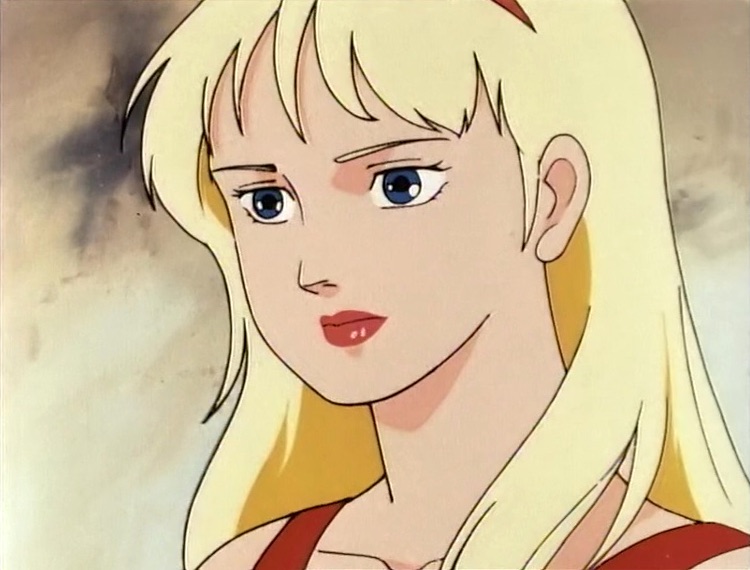
- In the episodes made by WEP April is always seen with lipstick applied. Was it intended to make her look more „adult-like“? Were the Star Sheriffs supposed to look older than they actually are in the Japanese version?
I believe this was an artistic decision made by the animation director and the artists in Japan, not by us. I think the Japanese team thought April looked better that way. I wouldn’t read any more into it than that.
- Why weren’t there any Renegade fights in the episodes from WEP? Was that decision deliberate to differentiate the episodes from the Japanese „Godzilla“ format or was the graphical effort too much?
Of course, we loved Ramrod and his fights with the Renegades, that was a key part of the series. However, those sequences were expensive to produce, and they did not fit with our goals for the new episodes. We were trying to use those episodes to set up the series so it would reach American and Western viewers, so we focused on the character of Saber Rider and other characters and elements. Not having a Ramrod Renegade fight gave us more time in each episode to focus on those key issues. Since we weren’t making any changes to Ramrod in our version of the series, we thought that leaving Ramrod and the Renegades out of those episodes would not harm the episodes, in fact it might bring some variation to the series.
- The order of the episodes in the US seems to be wildly jumbled compared to the Japanese episode order (Commander Eagle being missing in one episode and in the next he’s back; Gattler showing up after his final episode). What were the reasons for this change? Was for marketing reasons (sales of toys, etc.) the variety of characters prefered over a chronologically correct order?
The series was syndicated in the USA. That means it was shown by local stations not by a national network. Local stations at that time did not want to be constrained by a set order of episodes. They just played the shows in any random order, playing them over and over as long as the series was running. A production company like WEP could hope that the local stations would play the first two or three episodes in order and the last two or three in order, but other than that we didn’t control the order. Most such series did not have an uber-story that involved all of the episodes. Except for the beginning and the end, they were all considered stand-alone episodes. Much if not most programming for regular American series at that time were like this. E.g. Gunsmoke, Star Trek, He-Man — most episodes were stand-alones.
- Where were the amazing sound effects taken from? Was it an inhouse production or an extern company?
Paul Vitello did the sound effects. His company was Vitello Productions. He was a key part of the creative team.
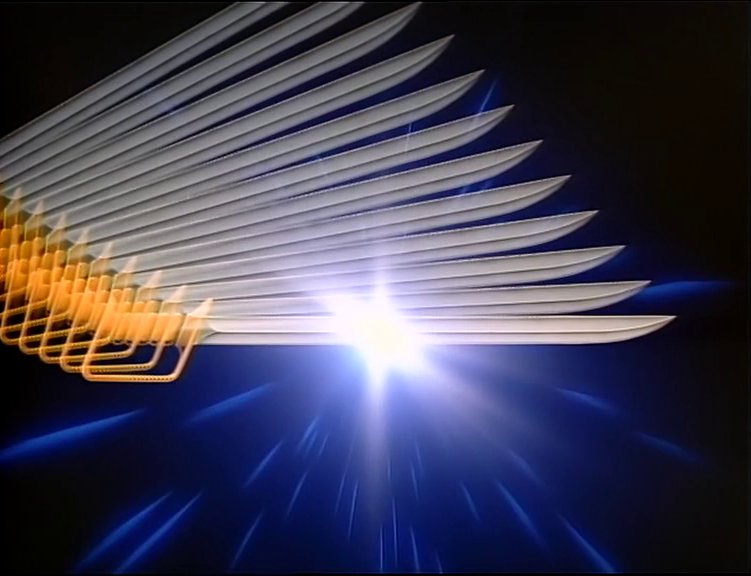
- There are typical transitions in the episodes like the famous falling sword from the intro or the „Whoosh“ transitions in green and brown to indicate a quick change of scenery. In the German version (and presumably international version) of Saber Rider there are extra transitions wich aren’t present in the English version. Why is that? Are there multiple versions of the episodes?
I assume those transitions were added by the company that bought the rights in Germany. I was not involved in the international distribution, and I don’t think WEP was involved in those decisions.
- Was WEP the editor for every country or could every national broadcaster do an own edit? Because the synchronization was done by national synchro studios anyway!
Each company in each nation changes the show as necessary to conform to the broadcast requirements in their country and to tailor it to reach their audience – they need to have the flexibility to do that. So they record the voices in their language, and they may change the music and may re-edit the footage for length or content. I was not involved in the international distribution, and I don’t think WEP was involved in foreign editing decisions either.
- Was WEP satisfied with the success of Saber Rider in the US? Were there thoughts of producing more episodes even without any more Japanese material to rework?
I think the show did well. It was in competition with shows from very large powerful companies with lots of distribution might and advertising and promotion dollars, yet Saber Rider managed to get syndicated in most of the USA and also sold to other countries. In the USA, it was not a smash hit, but it was well-liked and I believe it was moderately profitable. I would have loved to see more episodes and I think the creative team all felt that way, but that was ultimately a financial decision made by WEP.
We would like to thank Marc Handler for answering our questions!
Images, unless otherwise stated: © PIERROT / under licence to WEP LLC